
BOP Federal Release Route
The Federal Bureau of Prisons Inmate Locator is the correct public search when a person served a federal sentence. It is separate from East Hartford Police, the Connecticut Judicial Branch, and CT DOC. A local arrest does not become a BOP matter merely because the person lives in East Hartford. Look for a federal arresting agency, a United States District Court case, a U.S. Marshals remand, or a known federal register number before choosing this route.
BOP states that the locator covers federal inmates incarcerated from 1982 to the present. That date range makes it useful for both current federal placement and many past federal releases. Records before 1982 may require archival research rather than the modern locator. A person who spent time only in a municipal lockup or a Connecticut correctional center may not appear because those agencies do not belong to BOP.
Search BOP Release Records
The locator offers two practical paths. A number search is strongest when the exact identifier is known. The research identifies BOP register, DCDC, FBI, and INS numbers as accepted number types. A name search is available when no number is known, but similar names require close comparison of age, race, sex, and register number.
- Open the official BOP locator and choose number or name search.
- For a number search, select the identifier type and enter the full value.
- For a name search, enter the known first, middle, and last name information.
- Compare each result’s name, register number, age, race, and sex.
- Read the release date and location together, not as isolated fields.
- If the record is unclear, preserve the register number for a focused BOP records inquiry.
A spelling variation, legal name change, alias, or incomplete identifier can affect a name search. Do not force a match. A BOP result should be connected to the East Hartford person by more than a shared name, especially when the locator returns several people.
Note: A BOP register number is the best key for matching federal custody and later federal record requests.
BOP Federal Release Fields
The BOP result fields have a specific federal meaning. They can show identity, federal location, and a release date, but they do not supply a full court judgment or explain every later supervision condition.
| BOP field | How to read it |
|---|---|
| Name and register number | Primary identity and federal record key. |
| Age, race, and sex | Comparison details used to avoid a false name match. |
| Release date | A projected date when future, or a reported BOP release date when past. |
| Location | The current federal facility when one is listed. |
| No facility with past date | BOP’s indicator that the person is no longer in BOP custody. |
A future release date is not fixed forever. BOP explains that sentence reviews and First Step Act credit calculations can change the date. A past release date is more direct, but it speaks only to BOP custody. Supervised release, a state warrant, a new case, or another authority may still affect the person after the federal facility entry disappears.
Past BOP Release Dates
The most important released-person clue comes from BOP’s own locator records explanation. When the displayed release date is in the past and no facility location appears, BOP says the person was released on that date and is no longer in BOP custody. That rule helps distinguish a federal release record from an active federal placement.
The source page below shows BOP’s explanation of locator records and past release dates.
The BOP locator records source provides the past-date and facility explanation pictured here.
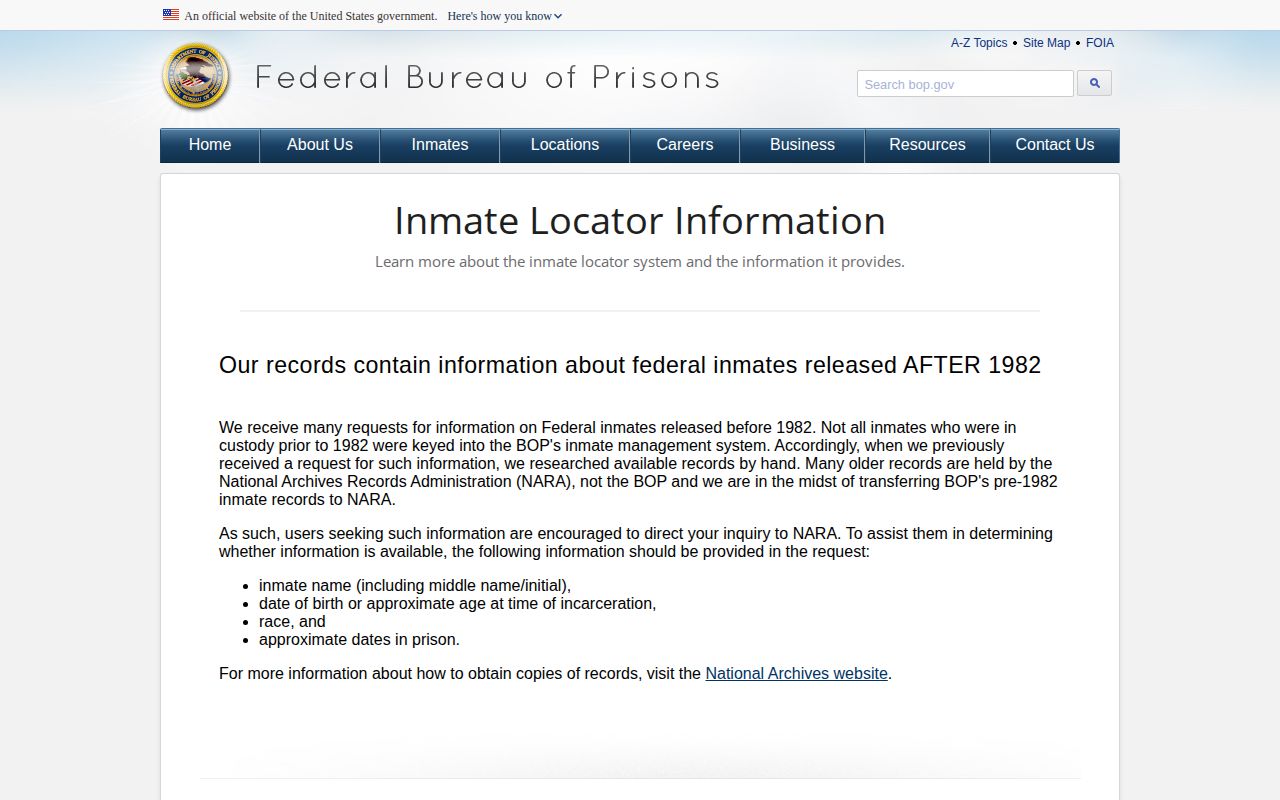
The screenshot supports reading the date and facility fields as a pair rather than assuming that a date alone settles current status.
“Not in BOP custody” is carefully limited language. It does not mean the underlying federal case vanished. It also does not establish that the person is free from supervised release, parole in an older case, state custody, or immigration detention. Use the federal court record and any known supervision paperwork to understand what followed the BOP release.
USMS Before BOP Custody
The U.S. Marshals Service handles many federal defendants before they enter a sentenced BOP placement. USMS says it takes custody of people arrested by federal agencies and manages detention placement and transport through the pretrial process. After an initial hearing, a federal defendant may be released or remanded. That early path may not appear in the BOP locator as a normal sentenced-inmate record.
If the East Hartford person was arrested in a federal case but has no BOP result, check the federal court docket and known U.S. Marshals custody information. A remand is a court order keeping the person in custody while a case proceeds. Acquittal, bond release, dismissal, or another court order may end that custody before a BOP sentence exists.
- Remand
- A court order that keeps a defendant in custody.
- BOP custody
- Federal prison custody administered by the Bureau of Prisons.
- Supervised release
- Court-ordered federal supervision after a prison term.
- Release date
- The projected or past date displayed in the BOP locator record.
Note: Federal pretrial custody can exist without the kind of sentenced BOP record most users expect from the locator.
East Hartford Federal Boundaries
CT DOC remains the correct system for a person remanded in a Connecticut criminal case. Hartford Correctional Center and York Correctional Institution are state facilities, not federal prisons. VINE may provide a participating Connecticut custody alert. The East Hartford weekly arrest log supplies local arrest and court-date information, but it does not report BOP release dates.
| Known custody path | Correct first source |
|---|---|
| East Hartford police-stage arrest | Police record and Connecticut court case |
| Connecticut remand or sentence | CT DOC inmate information |
| Federal sentence | BOP Inmate Locator |
| Federal pretrial remand | Federal court and USMS path |
| Immigration detention | ICE Online Detainee Locator |
The East Hartford release records overview begins with the type of custody because that choice prevents searches in the wrong system. A missing BOP result does not prove release when the person was never in BOP custody or is still in an earlier federal stage.
Obtain BOP Release Records
The public locator is the first federal checkpoint. For more detail, use BOP’s records and Freedom of Information Act process. A focused request should identify the full name, date of birth, register number, known facility, and relevant date range. Identity certification or consent may be required for records that are not available as ordinary public locator data.
Ask for the precise record needed, such as public confirmation of federal incarceration dates, the displayed release date, or facility history that may be disclosable. A federal court docket may be more useful for the judgment, sentence, and supervised-release term. The locator and court record answer different questions: BOP tracks its custody, while the court controls the judgment.
After a past date and blank location appear, preserve a copy of the visible locator details and verify any unresolved issue with the appropriate federal source. If the concern is current state or immigration custody, move to that authority rather than asking BOP to speak for a separate system.
BOP Release Follow-Up
Location must be read with the release date. A named institution supports current federal placement as reported by BOP. A blank location paired with a future date should not be recast as release, since the record may be updating or require direct confirmation. Copy the register number and exact display before contacting BOP. Those details help the agency distinguish a locator question from a request for a court judgment or another authority’s record.
USMS may place a federal defendant in a contract detention site that is not a BOP prison. Such placement does not turn a Connecticut facility into part of BOP, nor does it guarantee a normal locator entry. Federal detention and release orders remain central during the pretrial stage. Once a sentence and BOP designation exist, the locator becomes the stronger public custody checkpoint.
If an East Hartford address is the only federal clue, first confirm that a federal case exists. A local address does not establish BOP custody. Conversely, a person can lack a recent East Hartford police record and still appear in BOP because federal custody is nationwide. Search by federal identifiers and identity fields, not by an assumed local facility.
A final BOP check should preserve the result’s date, location, and register number together. If later information conflicts, return to the live locator and the federal court record rather than relying on an undated copy. The BOP record establishes federal custody context, while the judgment and supervision documents explain the legal term that follows release.