
East Hartford VINELink Coverage
Connecticut VINE is a custody-status and notification service for participating agency feeds. It can help track one person after an East Hartford arrest moves beyond the police stage. That point matters because East Hartford has no county sheriff jail. Adult male pretrial custody may move to Hartford Correctional Center, while women held by CT DOC may be at York Correctional Institution. VINE should be checked alongside CT DOC and the court case.
VINE is not the town's weekly arrest report, a court disposition database, or a permanent archive. A person released by citation or bond before entering DOC custody may have police and court records without a useful VINE entry. A person in state custody may have an agency result and notification options. Coverage depends on the participating source and the current interface.
- Custody status
- The participating agency's current reported state for the person.
- Transfer
- A move between agencies or facilities, not necessarily a release to the community.
- Remand
- A court order placing a person in custody while the case proceeds.
- Discharge
- The end of a custody or sentence stage as labeled by the responsible agency.
Search East Hartford VINELink Records
Use identifying details from the East Hartford arrest log, court file, or personal paperwork before opening the search. Common names can produce false matches. An offender or agency ID is more precise when one is available, but a name search can still work if the result is compared carefully.
- Open the current VINELink platform and select Connecticut.
- Enter the person's name, or use the offered ID field when a reliable number is known.
- Compare date of birth, age, agency, facility, and other displayed identifiers before choosing a result.
- Open the record and read the custody wording exactly. Do not treat a transfer as release.
- If no match appears, retry spelling and compare the CT DOC search and court record.
- For official proof, contact the agency whose status appears in the result.
The broader East Hartford released inmate search path explains how police, court, DOC, VINE, federal, and registry records fit together when the correct custody type is not yet known.
The official current search interface is shown below through its VINELink source page.
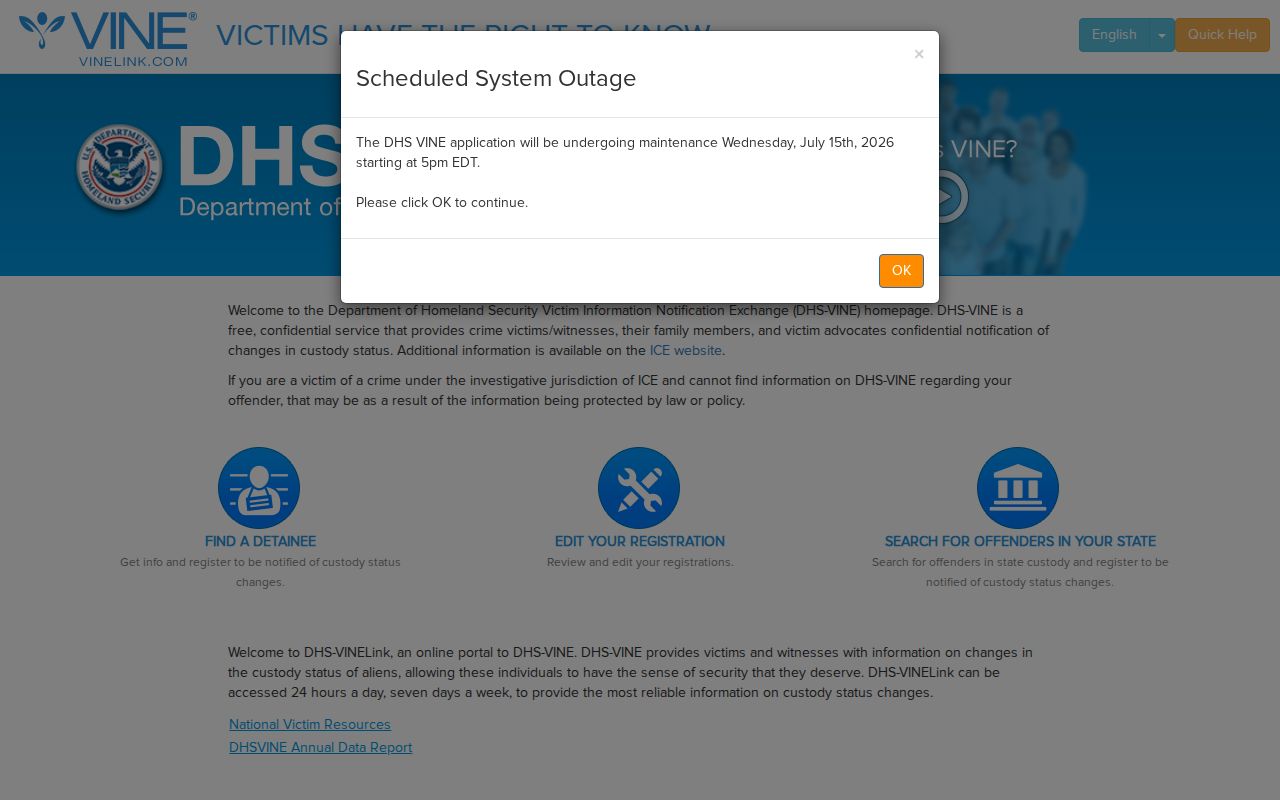
The screen is the entry point for a specific-person lookup, not a browseable East Hartford release list.
East Hartford VINELink Release Fields
The displayed fields can vary by agency feed and person. VINE may show a released or not-in-custody message and may include date or agency context. Do not promise that every result has the same date label. Preserve what the live record actually says.
| Field or result | How to read it |
|---|---|
| Name or offender ID | Identity key that must match the intended person. |
| Custody status | Reported state such as in custody, released, or not in custody. |
| Facility or agency | Shows which participating source supplies the status. |
| Status date | Use only when displayed and keep the interface's exact label. |
| No result | Does not prove that no arrest, custody, or release occurred. |
For state custody, compare VINE with CT DOC inmate information. CT DOC supports searches using inmate number, last name, first name, and date of birth. A current facility or active status points to state custody. A release or discharge clue should be confirmed if the date or status is unclear.
Note: Public status systems can lag an event, so a VINE message and CT DOC result may differ briefly after a release or transfer.
Register East Hartford Release Alerts
Registration begins from the correct specific-person result. Connecticut victim-notification material says notices may be delivered through the VINELink app, phone, email, or text, depending on the choices available in the interface. Multiple phone numbers and email addresses may be registered. Choose a method that can be checked and keep any confirmation information secure.
- Open the matched person record and select the notification or registration option.
- Choose phone, email, text, or app notice when offered.
- Enter and confirm the chosen contact information.
- Create or sign in to an account, or use the non-account registration route if available.
- When no account is used, enter a four-digit PIN for the new notification request.
- Keep the PIN because it may be needed to confirm or manage phone notices.
- After an alert, check the agency, court, or DOC record for the formal status and legal basis.
A notification reports a custody change. It does not decide the criminal case, explain all release terms, or guarantee that no other authority has custody. A move from CT DOC to another agency can trigger a change that is not community release.
East Hartford VINELink Limits
VINELink is not the right primary locator for every East Hartford custody path. Federal detention follows the U.S. Marshals and Bureau of Prisons systems. The BOP inmate locator covers federal inmates from 1982 forward and can show a release date and location. Immigration custody uses the ICE Online Detainee Locator. A state release followed by an ICE transfer is not the same as release from all custody.
Local police-stage releases also need a different source. The East Hartford weekly arrest report has a name, incident number, arrest date, court date, and charges, but no release status. If a person posted bond or received a promise to appear before entering DOC custody, police paperwork and the court case are the stronger sources.
When the person was in DOC custody, the CT DOC Public Information Office can address an unclear public result at (860) 692-7780 during its weekday information hours. For an East Hartford police release, ask the police records desk for the specific custody-disposition paperwork.
Connecticut VINE PIN Details
The four-digit PIN is a distinctive part of Connecticut's non-account notification route. The state victim-notification brochure says a PIN must be entered for each new request when no account is created, and the same PIN may be used for all notification requests. It is tied to managing or confirming notices, not to the inmate's DOC number or court case.
Do not use an easy-to-guess code if the interface permits a choice. Record which person and agency each notification tracks. This is useful when several alerts are active, since a transfer, release, and other custody change may arrive close together. If a phone message asks for the PIN, follow the official notification instructions rather than sharing it with an unknown caller.
The PIN does not make the alert an official release certificate. The final check still belongs with CT DOC, the court, East Hartford Police Records, BOP, or ICE according to the custody path.
Note: A person may leave one participating facility and remain under another authority, so read the event type before treating an alert as release.
Missing East Hartford VINELink Results
A missing match can have several supported explanations. The name may be spelled differently. The person may have been released at the police stage and never committed to CT DOC. An agency update may not yet be processed. VINE may not serve as a lasting archive after the person leaves a participating feed.
Return to the East Hartford arrest log for the incident number and court date. Then use the court case to test whether bond, probation, dismissal, nolle, or another disposition explains the custody change. If remand occurred, search CT DOC by inmate number when possible, since number searches reduce name-match errors. Contact the Public Information Office when the public result does not provide enough detail.
For a released person, court and agency records tend to last longer than a live notification result. They can explain why custody ended even after VINE no longer returns the person.
Use the court date from the East Hartford weekly arrest log as the bridge when a VINE search fails. The court case may show that the person was never remanded, posted bond, received probation, had the case dismissed, or was sentenced to time served. Those outcomes can explain why no active custody result exists. The court file does not replace an agency release record, but it can identify the legal action that ended or changed custody.
For an adult man held after arraignment, Hartford Correctional Center is a likely Hartford-area checkpoint. For a woman in state pretrial or sentenced custody, York Correctional Institution may be the relevant CT DOC facility. Search statewide rather than restricting the query to East Hartford. Connecticut's system follows state custody, so the agency listed in VINE may not carry the town name even when the arrest began with East Hartford police.
Also distinguish no current facility from confirmed discharge. A search result can change because of a transfer, data correction, or delayed update. Read the exact status and date label, save the agency name, and call the record holder when the result will be used to coordinate pickup, confirm a court obligation, or understand supervision. If parole or special parole follows, the Board of Pardons and Paroles and DOC supervision sources may supply the next part of the record.
VINE does not settle identity by name alone. Date of birth, age, offender number, agency, and facility should agree. If two records remain plausible, do not merge their details. Return to the incident number, court file, or DOC number and confirm through the source agency. This is vital when a common name produces more than one statewide result.
Keep a short record of the search terms and check time. That note helps explain later changes and lets an agency reproduce the lookup. Do not assume an alert date is the legal release date unless the official record uses it that way. A notification can describe when the feed changed, while police, court, or DOC paperwork states the action and authority behind the change.
Public Record Search
Sponsored Results