
Weapon Registry Release Role
The official Connecticut Deadly Weapon Offender Registry Unit page describes a registration office within DESPP and the State Police. It does not present the unit as an open name-search tool comparable to the public sex offender registry. That difference must guide every East Hartford lookup.
The unit says the duty applies to a person convicted, or found not guilty by reason of mental disease or defect, of an offense committed with a deadly weapon and released into the community on or after the qualifying date stated by the agency. The case and release facts matter. An arrest charge alone does not establish the duty, and a transfer between secure facilities is not the same as release into the community.
Connecticut Registration Requirements
DESPP’s page gives two concrete duties. A qualifying person released into the community on or after January 1, 2014 must register in person within 14 calendar days. The agency also states that information must be verified each year. Those are post-release compliance rules, not a way for the public to calculate the release date.
| Requirement | Agency description |
|---|---|
| Qualifying case | Conviction or specified mental-disease-or-defect finding for an offense committed with a deadly weapon. |
| Release setting | Released into the community, not merely moved between custody sites. |
| Qualifying release date | On or after January 1, 2014. |
| Initial action | Register in person within 14 calendar days. |
| Continuing action | Verify registration information annually. |
Each part should be established from the responsible record. The court judgment addresses the conviction or finding. CT DOC, a court order, or another releasing authority addresses when and how custody ended. The unit addresses registration procedure. No one source should be made to answer all three questions.
Note: A charge mentioning a weapon does not by itself prove that the final case created a registration duty.
Not a Public Release Locator
The deadly weapon unit should not be described as an online East Hartford offender search. The research found a state contact and registration page, not a general public search returning names and addresses. Readers looking for one released person must start with the custody system that actually held that person.
If East Hartford police released the person before state commitment, request the public police paperwork and review the court case. If a Connecticut court remanded or sentenced the person, use CT DOC inmate information and VINE. A federal sentence belongs in BOP. ICE ODLS applies only when immigration detention is supported by the facts. The registration unit is a later, conditional stop for a qualifying duty.
- Registration unit
- An office that receives and manages legally required registration information.
- Release into the community
- An end to secure custody that places the person outside a detention facility, subject to any lawful conditions.
- Annual verification
- The recurring duty to confirm required registration information.
- Locator
- A public search designed to return a person’s custody or facility record.
Weapon Registry Unit Contact
The unit’s official contact is in Middletown, not East Hartford. The page lists the Deadly Weapon Offender Registry Unit at 1111 Country Club Road, Middletown, CT 06457. The telephone number is 860-685-8465, and the fax number is 860-685-8005. A person with a possible duty should use the official unit instructions and direct questions to that office.
Connecticut Deadly Weapon Offender Registry Unit1111 Country Club Road
Middletown, CT 06457
Telephone: 860-685-8465
Fax: 860-685-8005
The official unit page shown below is the source for the contact details and registration terms.
The official registry unit source provides the contact and registration details pictured here.
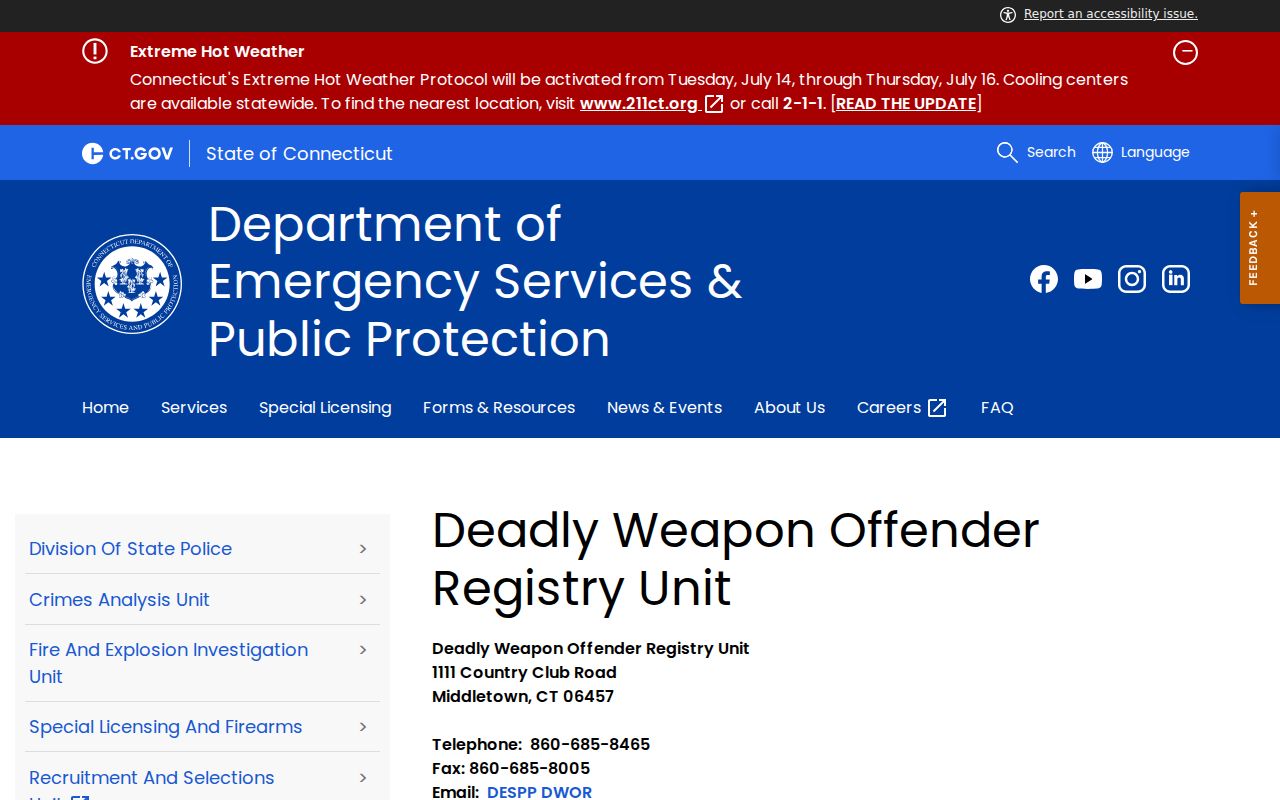
The screenshot links the post-release registration duty to the state unit without suggesting that the page offers a public person locator.
East Hartford Police Records cannot complete a state registration on the unit’s behalf. Local police or court records may help identify the incident and disposition, but DESPP controls the registration process described on its page.
Note: Contact the Middletown unit for registration procedure, while release proof remains with the agency that ended custody.
Verify Qualifying Community Release
Before applying the unit’s deadline, confirm the actual community-release event. A CT DOC status change may be a transfer to another prison, hospital ward, legal authority, or immigration detention. Those moves do not necessarily place the person in the community. Read the exact release type or destination in the agency record.
- Identify the final court disposition, not merely the arrest charge.
- Determine which agency held the person immediately before release.
- Obtain the release date, release type, and destination from that agency.
- Confirm whether the event was a community release or another custody transfer.
- Compare the court and release facts with the DESPP unit requirements.
- Contact the unit directly about registration steps or disputed applicability.
A person released on parole, special parole, probation, or another condition may still be in the community for registration purposes even though supervision continues. Supervision means legal oversight outside secure custody. The Board of Pardons and Paroles, the court, or CT DOC can explain that status, while the registration unit handles its own requirements.
East Hartford Registry Boundaries
East Hartford’s public weekly adult arrest log shows arrests, charges, incident numbers, and court dates. It does not show release date, custody status, bond posted, transfer destination, or final case disposition. Those omissions make the log unsuitable for deciding whether the deadly weapon registration rule applies.
Use the incident number and court date as research keys. The police record can document local handling and transfer. The court case can show the final offense and sentence. CT DOC can confirm state custody and release details. Only after those records establish a qualifying situation should the DESPP registration unit be treated as relevant.
The East Hartford release record process explains why Connecticut’s town, court, state, federal, immigration, and registry channels must remain separate. There is no Hartford County sheriff release roster to bridge those systems, so the source tied to each legal event is essential.
Connecticut Registry Distinctions
Connecticut’s public sex offender registry and the Deadly Weapon Offender Registry Unit are not interchangeable. The sex offender registry is described by CT.gov as a searchable public record with address, descriptor, and offense information for qualifying registrants. The deadly weapon page is described as a unit contact and registration-requirement source.
| Channel | Public role | What it cannot replace |
|---|---|---|
| Sex Offender Registry | Searchable records for qualifying registrants | Custody and release record |
| Deadly Weapon Registry Unit | Registration rules and unit contact | General public person locator |
| CT DOC search | State custody information | Final court judgment |
| Court case | Charge, disposition, and sentence context | Agency release paperwork |
Keeping these roles distinct prevents an unsupported claim that a person is registered, released, or currently at a given place. Use the exact public record for the exact question.
Preserve Registration Source Records
When registration information is needed for a legal or personal record issue, save the official unit page, note the access date, and retain the court and release documents that establish the qualifying facts. Do not treat an old arrest-log entry as the final case outcome.
A focused CT DOC request for a released person can seek public admission, facility, release or discharge date, release type, and supervision or transfer information. A focused East Hartford Police request can seek public booking, bond, release, or transfer paperwork linked to an incident. The court docket then supplies the disposition context.
The unit’s page should be quoted or paraphrased with precision. The January 1, 2014 date, 14-calendar-day period, in-person method, and annual verification duty are specific terms. They apply only within the state’s stated scope. Questions about an individual duty belong with the unit or suitable legal counsel, not with a generalized online release search.
Registry Unit Release Follow-Up
Because the unit page is not a general public name search, absence from that web page says nothing about an individual registration duty. The page explains the rule and contact method. Applicability must be resolved from the qualifying court and release facts with the responsible state unit. Keep the official response with the judgment and release paperwork so each source retains its proper role.
If a court or release record is corrected, provide the current document when contacting the unit. Do not assume that a change to one agency’s record will flow at once to another. The Middletown unit can explain its own registration file, while the court and releasing authority remain responsible for their records. This split is central to an accurate East Hartford release inquiry.