
Connecticut Board Release Paths
The Connecticut Board of Pardons and Paroles becomes relevant after a state prison case reaches parole or special parole. Parole is conditional community release granted through the parole process before the full correctional term ends. Special parole is a court-imposed period of parole supervision that follows incarceration. Both differ from probation, which is ordered and administered through the Judicial Branch.
The Board's records can also involve revocation, rescission, and early termination. Revocation examines whether parole should be taken away after an alleged violation. Rescission concerns withdrawal of a grant before release in the applicable process. Early termination review asks whether supervision may end ahead of its planned date.
| Release or review | Best source |
|---|---|
| Parole release | Board hearing record and CT DOC |
| Special parole | Court sentence, Board, and DOC |
| Probation | Judicial Branch, not the Board |
| Revocation or rescission | Board hearing record |
Confirm Connecticut Parole Releases
Begin with the Connecticut DOC inmate search to establish the person and state custody record. Then review the Board hearing page and event calendar for the relevant proceeding. A hearing date is not the same as an actual release date. The decision, DOC status, and supervision record must align.
Use this sequence:
- Match the person by DOC number, name, and date of birth.
- Determine whether the sentence involves parole or special parole.
- Locate the hearing type and posted date when available.
- Request the official hearing record when public pages do not answer the question.
- Confirm current custody or community status through DOC and the supervising channel.
The East Hartford release search identifies when a police, court, or DOC record should be used instead.
Connecticut Board Parole Records
The Connecticut Board of Pardons and Paroles posts live hearing links, parole resources, contact information, and access to its hearing calendar. The Board states that members of the public may request a copy of a hearing through a Freedom of Information request sent to BOPPFOI@ct.gov. Include the person's name, DOC number if known, hearing type, and hearing date.
Connecticut Board of Pardons and Paroles
55 West Main Street, Suite 520
Waterbury, CT 06702
203-805-6605
Hearing-record FOI: BOPPFOI@ct.gov
The Board is headquartered in Waterbury, not East Hartford. Its record addresses the parole action, while DOC supplies the state custody and discharge status. The court supplies the sentence and any special-parole term. A complete check may need all three.
Note: Ask for the official hearing copy when a livestream or calendar entry lacks the decision detail needed.
Connecticut Board Hearing Records
The hearing page says hearings start at 9 a.m. unless another time is posted. It publishes current virtual-hearing links and includes revocation and early-termination review among the proceedings. The public-viewing rules warn that recording, screenshots, and screen captures of livestreams are prohibited except for the Board's official recording.
The official Board source shows the live hearing and contact path used to trace parole release records.
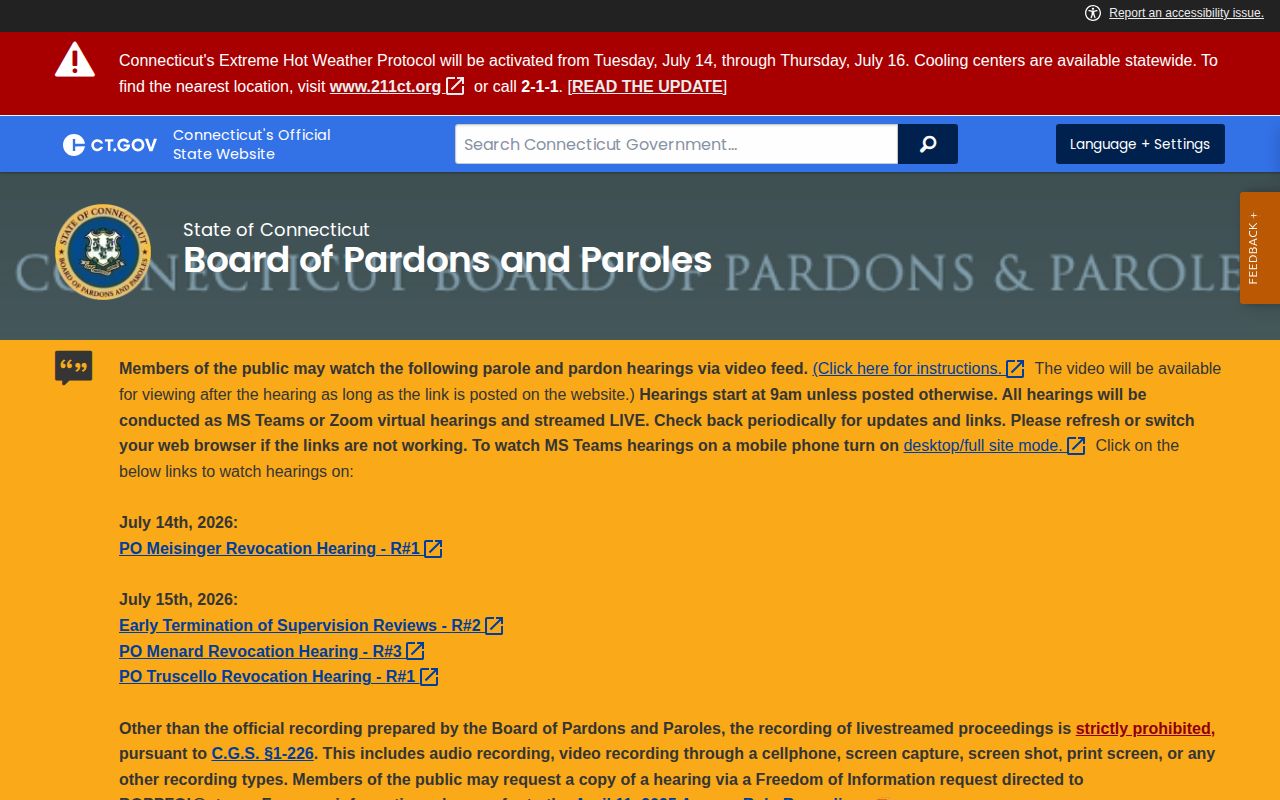
The Board page provides the hearing layer, while the official copy requested through FOI is the controlled record when a calendar entry is not enough.
- Parole
- Conditional community release through the parole process.
- Special parole
- A court-imposed supervision term after incarceration.
- Revocation
- Review that can return a parolee to custody.
- Discharge
- The end of the applicable custody or supervision term.
East Hartford Parole Proof
East Hartford's weekly arrest log cannot show parole. It records the arrest and a court date, but not a later prison release or supervision term. The court sentence is the bridge to DOC and Board records. If the person was only released on bond or placed on probation, the parole path does not apply.
For a state prisoner, compare the sentence, Board proceeding, and DOC status. A grant can be subject to conditions and a later effective date. A person may also face rescission before release or revocation after community release. The official record and current DOC status resolve those differences.
Note: “Out of prison” can still mean active parole or special-parole supervision rather than full discharge.
Connecticut Parole Supervision Checks
Parole and probation are often confused. Parole follows release from a state prison sentence and involves the Board and DOC supervision. Probation is imposed by a court and handled through the Judicial Branch Court Support Services Division. A person can have special parole after incarceration because the court included that term in the sentence.
Board material can show hearings and reviews. CT DOC information can show custody or community-supervision clues. The court record confirms the sentence. If a parolee is alleged to have violated conditions, a revocation process may change the status and lead back to custody. An early termination review may instead end supervision sooner.
Do not treat a hearing calendar as a public inmate roster. It serves a narrower purpose. Search the person's correctional record first, then use the Board's official pages or FOI process for the proceeding that affects release or supervision.
Connecticut Board Hearing Checks
Begin with the hearing type. A release consideration hearing, revocation hearing, rescission matter, and early-termination review answer different questions. The posted schedule may give a date and public-viewing link, but the calendar alone does not establish the final result. Request the official record when the outcome is not available in enough detail.
Use the person's full name and DOC number to avoid confusion. Include the scheduled hearing date and category in an FOI message to BOPPFOI@ct.gov. The Board's public-viewing rule matters: do not make a private recording or screen capture of the livestream. The official recording is the source to request through the Board.
Next, compare the Board record with Connecticut DOC inmate information. A favorable parole action can have a later effective date or conditions that must be met. DOC status confirms whether the person remained in a correctional facility or moved into the community. VINE can provide a custody alert, but it does not replace the decision record.
For an East Hartford case, also keep the court sentence. Special parole is imposed as part of the sentence, so the docket explains its legal basis. Ordinary probation belongs to the court supervision system and may exist without any Board hearing. The correct label prevents a court release from being misreported as parole.
Connecticut Parole Release Outcomes
A parole release can place a person in the community while legal supervision continues. Full discharge comes later when the applicable custody and supervision obligations end. Early termination may shorten supervision after review. Revocation can lead back to custody, while rescission may stop a planned parole release before it takes effect.
These changes are why an old hearing notice should not be treated as current status. Check the latest Board matter, DOC result, and court sentence. If the online pages conflict, ask the Board for its hearing record and DOC for current inmate information. Preserve the response date because supervision status can change.
The Board does not confirm an East Hartford police bond-out. It also does not maintain the town arrest report or an East Hartford recent-release feed. Its role begins only when the state sentence and parole system make it relevant. Routing the inquiry by custody type keeps the release record accurate.
Connecticut Board Record Matches
Match a Board record by more than a name. Use the DOC number, date of birth, court docket, sentence, and hearing date. A common name can appear in more than one correctional or court record. The hearing category must also fit the question being asked.
A current DOC facility points to confinement even if a parole proceeding has occurred. Community status may indicate release under supervision, but the exact label should be verified. A past hearing link proves only that a proceeding was scheduled or streamed. The official Board record supplies the action and decision.
After release, supervision can change. A violation allegation may lead to revocation review. The Board may also consider early termination. Each later event can make an older release record incomplete as a statement of current status. Check the newest official material and record the date of the inquiry.
Families seeking to reconnect or confirm a release should use the FOI channel for the Board record and the Public Information Office for DOC custody data. The Judicial Branch docket completes the sentence context. This three-source check is especially useful for special parole because the court imposes the term, DOC tracks custody, and the Board handles the parole process.